
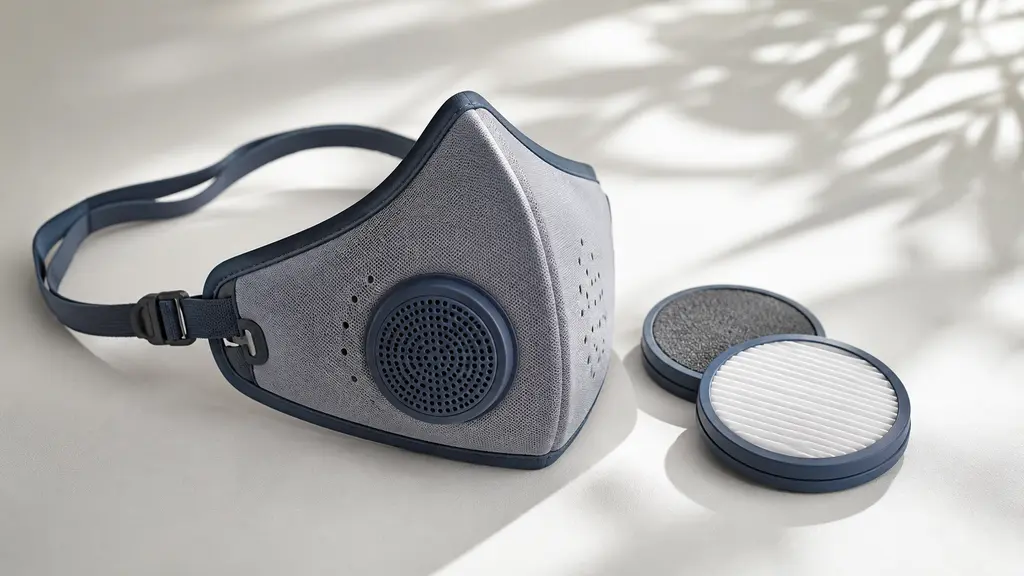
Anti-pollution masks are often considered during episodes of elevated fine-particle pollution, as air pollution remains a serious public-health concern across many Indian cities. A properly certified, well-fitting particulate respirator may reduce exposure to airborne particles when correctly selected and worn, but no mask removes every risk, and evidence of improved health outcomes from routine public use in real-world urban conditions remains limited. Respiratory protection, where appropriate, should be considered only as one possible layer alongside official air-quality guidance, reduced outdoor exposure when pollution is severe, cleaner indoor air where practical, and advice from a qualified healthcare professional when individual health conditions are involved.
Understanding PM2.5 and urban air pollution
PM2.5 refers to airborne particles with an aerodynamic diameter of 2.5 micrometres or smaller. Common sources include vehicle exhaust, road and construction dust, industrial activity, power generation, waste burning, and seasonal biomass burning. These particles can penetrate deep into the lungs, and some components may reach the bloodstream. Long-term or repeated exposure is associated with respiratory and cardiovascular harm, although an individual reader’s risk depends on exposure level, duration, age, health status, and other factors.
Urban air can also contain gases and vapours, including nitrogen dioxide, sulphur dioxide, carbon monoxide, ozone, and volatile organic compounds. A particulate respirator is designed primarily for particles. It should not be assumed to protect against gases or vapours unless the exact product has a suitable, verified cartridge or filter specification for the particular contaminant and expected concentration.
Face coverings, surgical masks, and respirators are not the same
Cloth face coverings and loose-fitting surgical masks do not provide the same reliable respiratory protection as a properly fitted, certified respirator. Their filtration and facial fit vary, so they should not be described as equivalent to N95-, FFP2-, or similar respirators. A surgical mask may have useful source-control or splash-related functions in appropriate settings, but its loose fit allows air to enter around the edges.
N95 and FFP2 are separate standards. They are broadly comparable in their intended particle-filtration role, but they use different test methods, flow rates, and certification systems and should not be described as identical. Buyers should check that the product carries traceable certification information for the exact model rather than relying only on marketing terms printed on a marketplace listing.
Five checks before considering an anti-pollution mask
1. Verify the exact certification
Look for the precise standard, model number, manufacturer, certification or approval details, and any notified or testing body information shown on the product and supporting documents. A familiar label alone is not proof that a particular unit was tested or certified.
2. Prioritise fit
A high-rated filter cannot perform as intended when air leaks around the nose, cheeks, or chin. Fit varies by face shape, facial hair, head straps, and movement. Glasses fogging may indicate leakage near the nose, but it is not a complete fit test.
3. Read the use limitations
Check whether the product is intended only for particles or also claims performance against specific gases or vapours. Activated carbon may reduce some odours or certain contaminants, but performance depends on the carbon quantity, filter design, contaminant, concentration, humidity, service life, and verified testing.
4. Follow the manufacturer’s replacement and cleaning instructions
Filter life cannot be safely converted into one universal number of hours or one “full winter.” Pollution load, humidity, storage, breathing rate, and product design all affect service life. Replace the filter according to the current instructions and earlier if it is damaged, contaminated, difficult to breathe through, or otherwise unsuitable. Do not wash a filter unless the manufacturer expressly permits it.
5. Consider health and age-related cautions
Tight-fitting respirators can increase breathing resistance and may not be suitable for every person or activity. People with respiratory or cardiac conditions should seek individual medical advice before using one. Adult respirators should not be assumed to fit children, and a caregiver should not rely on an adult product merely because it can be tightened.
A neutral way to assess reusable urban-mask brands
Readers comparing reusable urban-mask designs may encounter brands such as R-PUR, which markets replaceable-filter masks for activities such as cycling, running, and motorcycling. Before purchasing, readers should verify the exact current model, certification markings, supporting test documents, fit instructions, stated use limitations, filter-replacement schedule, warranty terms, and availability in India. Manufacturer statements about particle size, filtration percentage, gas reduction, comfort, or filter life should be treated as product claims unless they are supported by current, independently verifiable documentation for the exact model. The product has not been independently tested by the publisher, and this article does not guarantee its safety, effectiveness, fit, or suitability for any individual.
Any claims, specifications, certificates, comparisons, testimonials, prices, warranties, or performance statements appearing on the linked manufacturer website are third-party commercial content and are not adopted, independently verified, or endorsed by this article.
Using air-quality information responsibly
Use official or reputable local air-quality information and follow the health advisory attached to the reported category. A single AQI number should not be turned into a universal instruction that a particular mask is “essential” for every reader. Health advice may vary for children, older adults, pregnant people, outdoor workers, athletes, and people with asthma, COPD, heart disease, or other conditions.
When pollution is elevated, practical exposure-reduction steps may include changing the time or location of outdoor activity, reducing strenuous outdoor exertion, keeping windows closed when outdoor air is particularly poor where this is safe and practical, and using appropriately maintained indoor filtration. A respirator is one possible layer of protection, not a substitute for cleaner air, public-health measures, or medical care.
Practical conclusion
A properly selected and well-fitting respirator may reduce exposure to airborne particles while it is worn correctly, but it does not eliminate pollution-related risk. A cautious product assessment should consider traceable certification for the exact model, suitable facial fit, clear limitations, and current instructions rather than relying on rankings or promotional language. Readers with health conditions, breathing difficulty, or uncertainty about suitability should consult a qualified healthcare professional.
Disclaimer
This article is provided solely for general informational and educational purposes. It does not provide medical advice, diagnosis, treatment, a prescription, or a personalised recommendation. It should not be used to self-diagnose, self-treat, change medication, delay professional medical care, or determine whether a respirator or mask is suitable for a particular person or health condition.
WellHealthOrganic.com and the author are not doctors, licensed healthcare professionals, occupational hygienists, respiratory-protection specialists, testing laboratories, certification bodies, manufacturers, sellers, importers, or regulatory authorities.
This paid guest post contains a commercial link to R-PUR. The brand mention and external link are provided contextually and do not constitute an endorsement, recommendation, ranking, independent certification, or guarantee of authenticity, availability, regulatory status, safety, effectiveness, filtration performance, gas or vapour reduction, fit, comfort, durability, service life, or suitability for any individual. WellHealthOrganic.com has not independently tested or certified the linked product.
Any product claims, specifications, certifications, test results, comparisons, testimonials, prices, warranties, availability information, or other statements appearing on the linked website are made by the relevant third party. Readers should independently verify current documentation for the exact product model before purchasing or using it.
Readers should follow the current manufacturer instructions, verify recognised certification or approval information, and consult a licensed healthcare professional before using a tight-fitting respirator if they have respiratory, cardiovascular, pregnancy-related, age-related, or other health concerns. Adult respirators should not be assumed to fit or be suitable for children.
External websites, products, transactions, privacy practices, sales terms, delivery arrangements, and commercial conduct are controlled by third parties. WellHealthOrganic.com does not guarantee the accuracy, completeness, safety, legality, availability, or reliability of external content, products, or services.
Reasonable editorial care has been taken in preparing this article, but medical guidance, product documentation, certifications, models, and manufacturer instructions may change. Readers should verify important information from current official sources.
To the fullest extent permitted by applicable law, WellHealthOrganic.com and the author disclaim liability for loss, injury, damage, or other consequences arising from reliance on or misuse of this general information. Nothing in this disclaimer excludes any consumer right or legal liability that cannot lawfully be excluded.
Images used in this article are illustrative unless expressly identified otherwise. They do not represent independent product testing or certification. Reading this article does not create a doctor-patient, professional-client, certification, agency, endorsement, or seller-buyer relationship.
Anyone experiencing severe breathing difficulty, chest pain, confusion, fainting, or another possible medical emergency should seek urgent assistance from qualified local medical professionals or emergency services.