

Healthcare can be confusing, especially when paperwork enters the equation. Most people simply want clear answers. What is this card for? Will it help during a hospital visit? Or is it only meant for records?
Over the last few years, two names have started coming up again and again: the ABHA card and the Ayushman card. Since both are linked to healthcare and government systems, it’s easy to mix them up. But in practice, they serve very different purposes. And once that difference is clear, decisions become much easier. Rather than thinking about which card is “better,” it helps to understand how each one is meant to help.
For a simplified explanation of the purpose and usage of the ABHA card, readers may explore third-party informational guides.
What the ABHA Card is designed to do
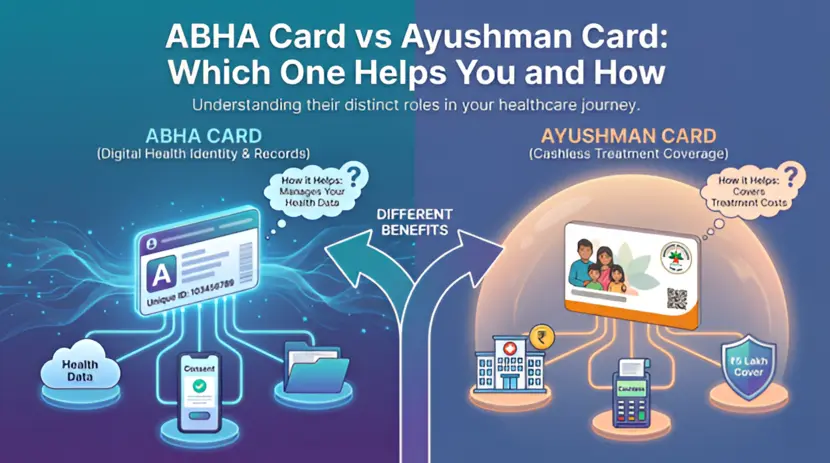
At its core, the ABHA card is about organising health information.
Think about how medical records usually exist at home. One file has prescriptions. Another has lab reports. Hospital papers are kept somewhere else. Over time, some reports go missing, others fade, and finding the correct document becomes a task in itself. This is where the ABHA card helps. Prescriptions, lab tests, hospital summaries, and consultation notes can be connected to a single digital account, subject to system availability and user consent, thanks to its functionality as a digital health ID.
Another thing that matters here is control. With the ABHA card, records are shared only with consent. The individual determines who can view their information and for how long.
In everyday life, this can be used for:
- People dealing with long-term conditions.
- Those who consult more than one doctor
- Anyone who prefers online consultations
What the Ayushman Card is meant for
The Ayushman card, on the other hand, comes into play when hospital costs become a concern. It is linked to the Ayushman Bharat health insurance scheme and is meant to support eligible families during hospitalisation. When someone needs to be admitted, and expenses start adding up, this is the card that matters.
For general awareness, readers can refer to third-party explanatory resources about the Ayushman card to understand how the scheme works.
For families who qualify, the Ayushman card may help cover certain treatments at empanelled hospitals. Eligibility is important here, and not everyone automatically qualifies.
What’s worth noting is what this card does not do. It doesn’t store medical records. It doesn’t track prescriptions or past treatments. Its role is limited to providing financial support during hospital care.
ABHA Card vs Ayushman Card
| Aspect | ABHA Card | Ayushman Card |
| Main purpose | Organising medical records | Covering hospitalisation costs |
| Type of card | Digital health ID | Health insurance support card |
| Pays hospital bills | No | Yes (for eligible families) |
| Stores medical history | Yes (with consent) | No |
| Eligibility-based | No | Yes |
| Useful for | Records, follow-ups, telemedicine | Hospital admissions, treatment costs |
| Mandatory | No | No |
Can one person use both?
Yes, and many people already do.
There is no connection between the two cards, and one does not take the place of the other. During a hospital stay, a patient may use the Ayushman card for expenses, and over time, they may continue to utilise the ABHA card to maintain organised medical data.
It’s also important to clear one common doubt. Having an ABHA card does not make someone eligible for the Ayushman scheme. Similarly, having an Ayushman card does not require ABHA registration. They work independently, each serving a different purpose.
Which one should you consider?
That really depends on your situation.
- The Ayushman card can be useful during hospitalisations and significant treatments.
- The ABHA card can be helpful for people who wish to maintain records and medical history more easily, particularly if they see many doctors or prefer online consultations.
Some decide to have both, allowing each card to serve a different purpose.
Final thoughts
Things feel less stressful when healthcare is easier to understand. The ABHA card and the Ayushman card are designed to help in different ways, one by keeping health information organised, the other by easing the financial burden of hospital care.
Important Information
ABHA Card and Ayushman Bharat (PM-JAY) are Indian Government schemes. The scope, eligibility, and benefits of government health schemes may change over time and are subject to official guidelines. References to government health schemes are provided for general awareness only. Linked resources may include third-party explanatory content and do not represent official government portals or endorsements.
Disclaimer
This article is published for general informational and educational purposes only. It is intended to provide basic awareness about the ABHA Card and Ayushman Bharat (PM-JAY) and does not constitute medical advice, legal advice, insurance advice, financial advice, or professional guidance of any kind.
ABHA Card and Ayushman Bharat (PM-JAY) are Indian Government health schemes. The scope, eligibility criteria, benefits, coverage, and implementation of government health schemes may change over time and are subject to official notifications, policies, and guidelines issued by the relevant authorities.
WellHealthOrganic.com and the author are not government bodies, medical professionals, insurance advisors, or authorised representatives of any public or private organisation. References to government health schemes are provided solely for general awareness and should not be interpreted as official guidance, endorsement, recommendation, or guarantee of benefits or eligibility.
Any external links mentioned in this article, including links to third-party websites, are provided only for explanatory or informational reference. Such links do not represent official government portals and do not imply endorsement, affiliation, or approval by WellHealthOrganic.com or by any government authority. Readers are encouraged to verify information directly from official government sources for the most accurate and up-to-date details.
Some references within this article may link to third-party informational websites for simplified explanations of government health schemes. These links are provided solely for general understanding and do not represent official government portals, registrations, applications, or endorsements. WellHealthOrganic.com does not control, verify, or take responsibility for the accuracy, completeness, or updates of third-party content
This article does not provide medical or healthcare advice. Readers should consult qualified healthcare professionals for medical concerns and refer to official government portals or authorised representatives for decisions related to government health schemes.
Images used in this article, if any, are for illustrative purposes only and do not represent real individuals, government offices, or actual events.
By reading or relying on this article, readers acknowledge that all decisions related to healthcare or government schemes are made at their own discretion and risk, and WellHealthOrganic.com and the author shall not be held liable for any loss, harm, or consequences arising from the use of this information.